Warehouse footage guide
How to Review Warehouse Security Footage for Motion
Warehouse recordings can cover large spaces for long periods. A focused motion scan can narrow saved footage to the moments when the entrance, main aisle, loading area, or another selected part of the frame changes.
Download MoFind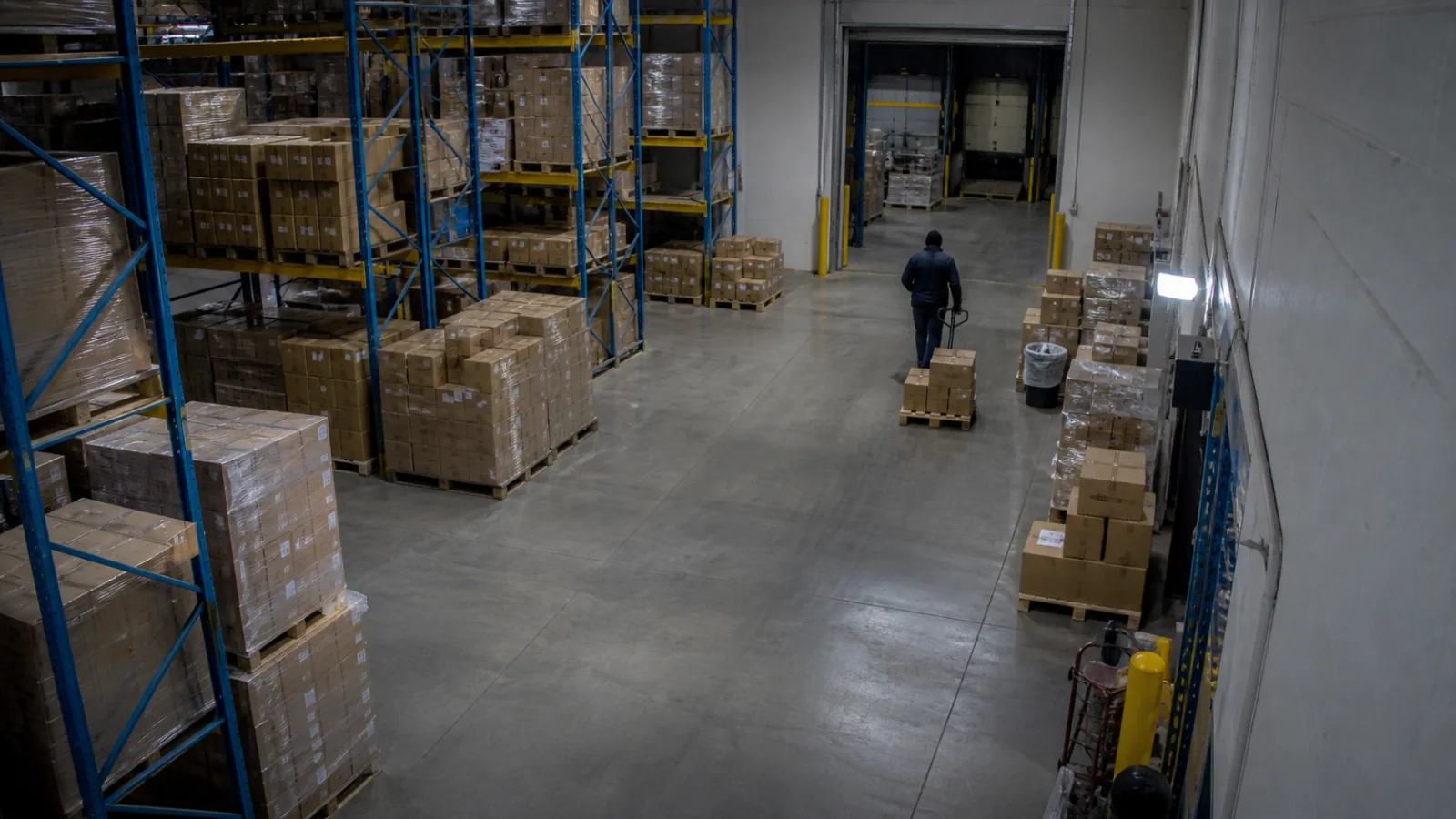
Why warehouse footage needs a focused review plan
A warehouse camera may cover shelves, open floor space, loading doors, and multiple aisles at once. Watching the complete recording is slow, while scanning the entire frame without a clear purpose can produce more events than you need.
Begin with one review question and one useful area: movement at an entrance after operations end, changes along a main aisle during a known period, or activity near a loading zone. This keeps motion scanning aligned with the footage you actually need to inspect.
Long recordings across shifts
A single file or a series of files may span several hours. Restricting the scan to a relevant shift or time window reduces unnecessary processing and review.
Large frames with several zones
Shelves, aisles, doors, and open floor areas may all appear in one camera view. A detection region helps separate the current review task from the rest of the frame.
Lighting and background changes
Loading doors, reflective wrapping, automatic lights, and overlay text can change the picture. Region placement and sensitivity affect how much of that noise reaches the event list.
Select the warehouse zone you need to inspect
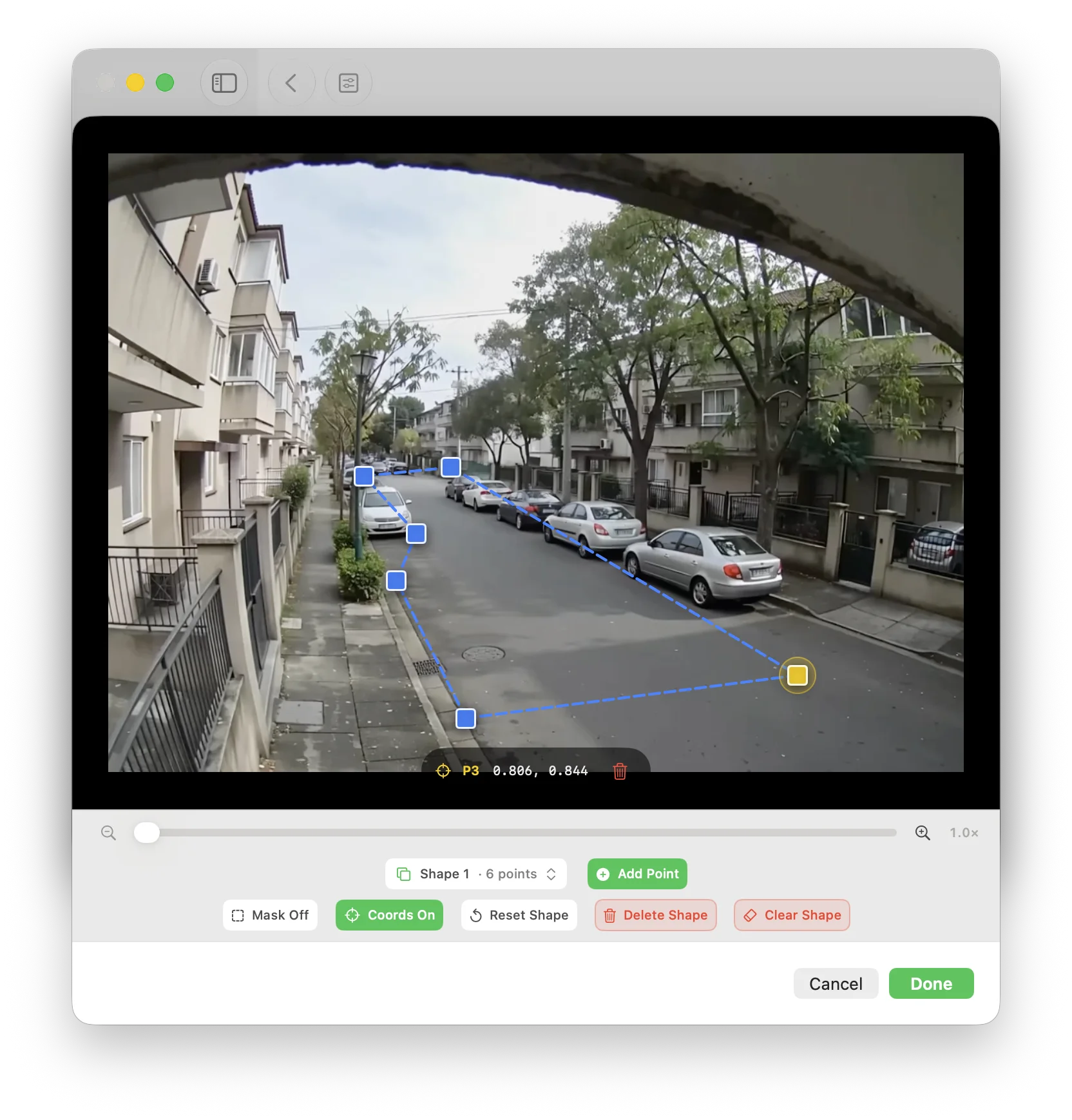
Place the detection region around a specific entrance, main aisle, loading bay, or another clearly defined part of the warehouse. When practical, leave bright doorways, reflective wrapping, timestamp overlays, and unrelated work areas outside the region.
For one review question, a single precise region is often easier to interpret than a broad region covering most of the frame. The free tier supports one region; Pro supports multiple regions when separated zones must be scanned together.
A practical warehouse footage workflow
MoFind analyzes saved video files; it does not connect to a live warehouse camera. Prepare the relevant recordings on the iPhone, iPad, or Mac that will perform the scan.
Collect the relevant saved files
Start with recordings from the camera and date that match the review task. General support includes MP4, M4V, and MOV using H.264 or H.265 when the device can decode them; macOS can use compatibility processing for more common formats.
Choose the shift or time window
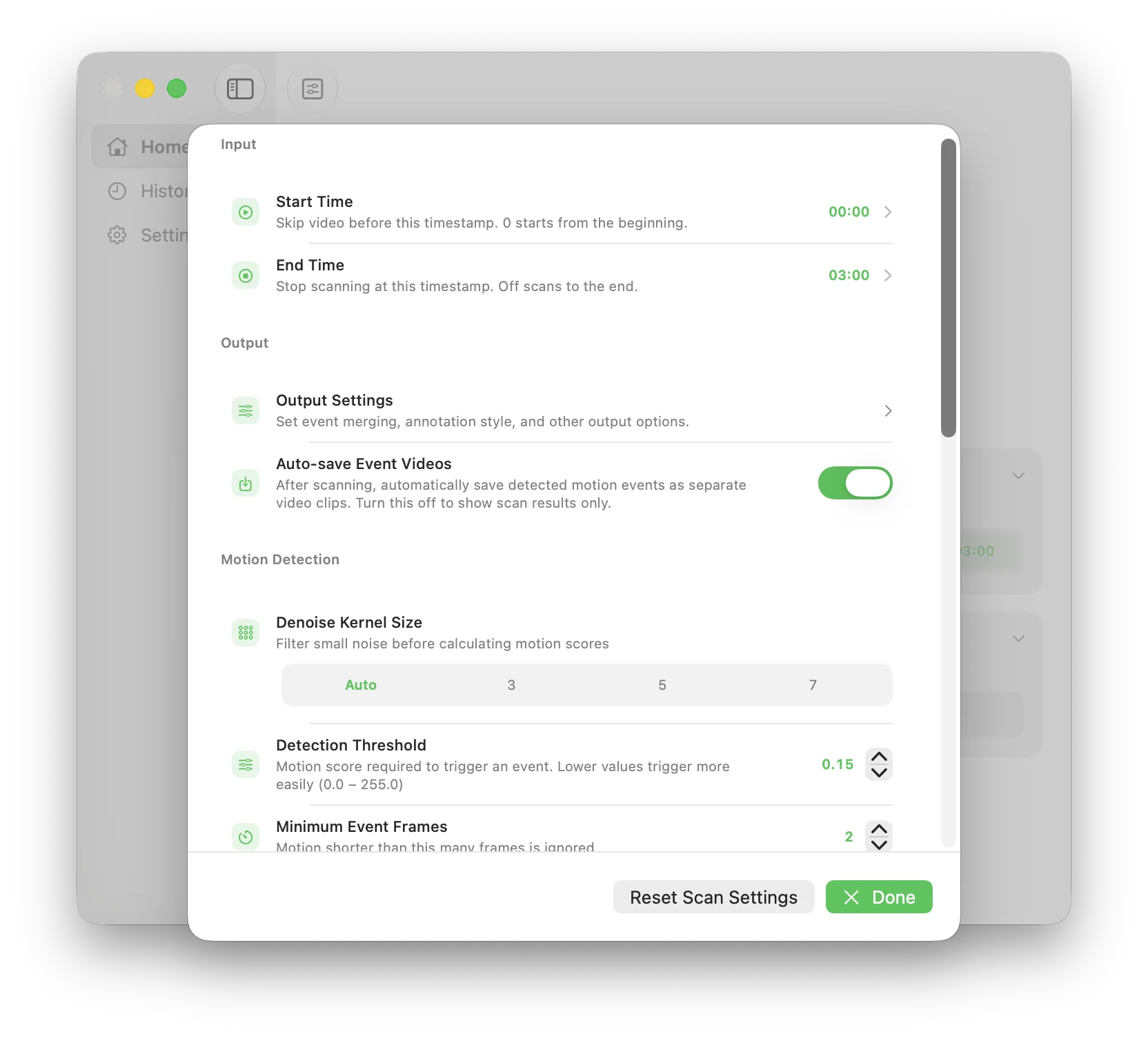
Scan only the hours that matter—for example, after operations end or around a known loading period—rather than processing the complete recording by default.
Focus on one operational zone
Draw the detection region around the entrance, aisle, loading bay, or storage area connected to the question you are reviewing.
Set sensitivity and start the scan
Use a preset first. If light reflections create too many events or smaller picture changes are missed, refine the region and sensitivity before scanning again.
Review the event list
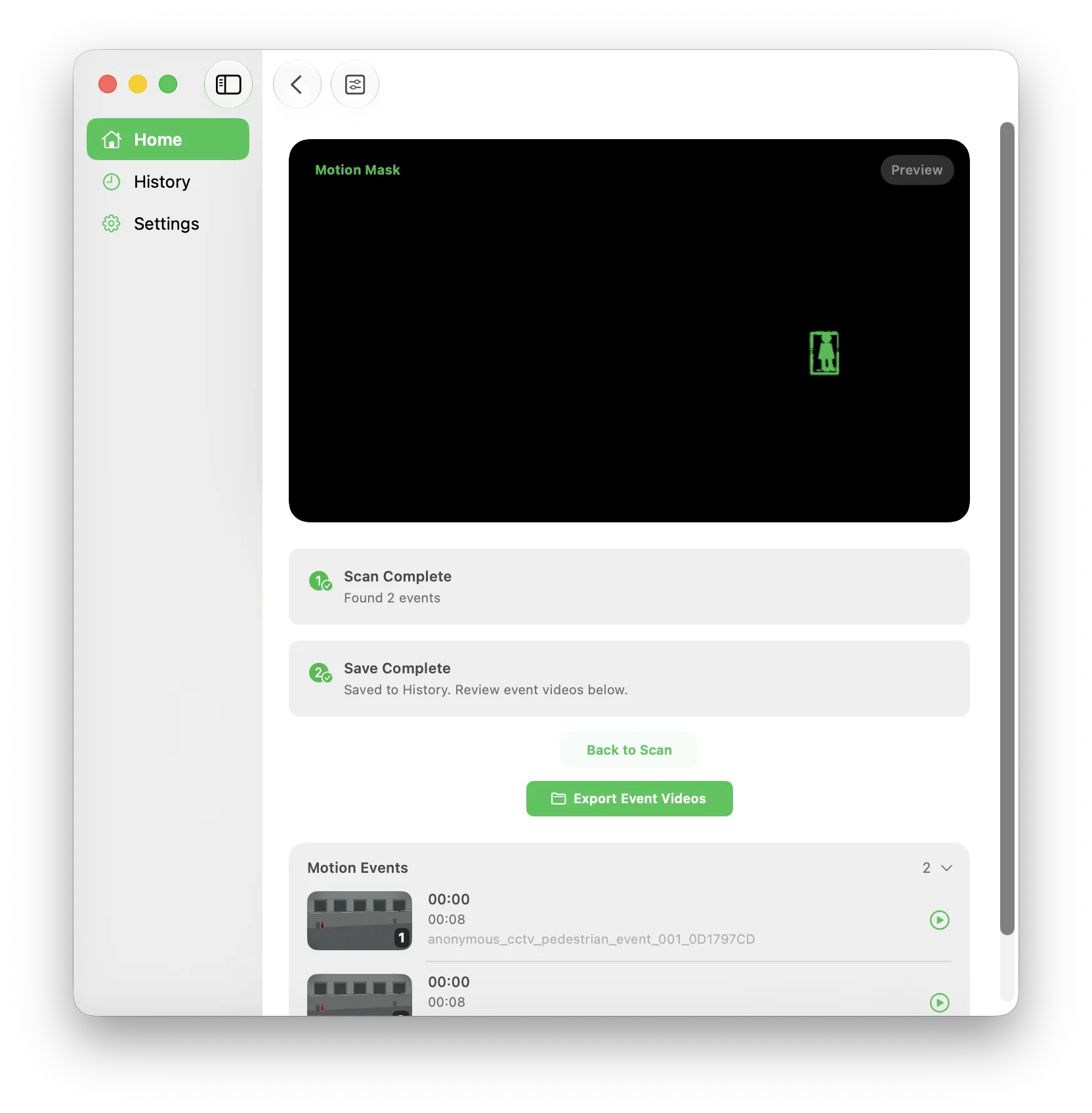
Compare timestamps, durations, motion scores, and thumbnails. Preview useful events before deciding whether to save or export them; event-clip export requires Pro.
Turn the event list into a manageable review
Treat each event as a point where the selected part of the frame changed. Use the thumbnail and preview to determine whether the event is relevant to your review question.
Review in chronological order
For shift-based footage, timestamps preserve the sequence of detected changes and make it easier to compare nearby events.
Use thumbnails as a first pass
Thumbnails help separate obvious lighting changes from events that deserve a closer preview without assigning an identity or meaning to the motion.
Keep separate scans focused
If you need to inspect both an entrance and a distant loading area, separate focused scans can be easier to review than one broad region with unrelated movement.
What warehouse motion scanning can—and cannot—show
MoFind performs motion analysis on the selected device, so saved warehouse videos are not uploaded for scanning. This is useful for footage that should remain local.
A detected event means the picture changed inside the selected region. It is not proof of a particular action, an inventory change, a safety incident, or the identity of a person in the frame.
Scans saved footage locally, focuses on selected regions and time ranges, and creates a reviewable list of picture-change events with timestamps and thumbnails.
It does not provide live monitoring, remote camera access, person identification, inventory recognition, incident detection, or automatic behavior classification.
Warehouse footage questions
Can MoFind scan long warehouse recordings for motion?
Yes. Import supported saved video files and choose the time range and region you need. The free tier supports one video up to 30 minutes; Pro unlocks longer videos and a multi-video queue.
Can I scan only a warehouse entrance or aisle?
Yes. Draw a detection region around the entrance, aisle, loading area, or other part of the frame you want to analyze.
Does MoFind identify workers or recognize inventory?
No. MoFind detects picture changes in saved video. It does not identify people, recognize inventory, or classify behavior.
Can MoFind monitor a warehouse camera live?
No. MoFind analyzes saved video files and is not a live monitoring client or remote camera viewer.
Are warehouse recordings uploaded?
No. Motion analysis runs locally on the selected iPhone, iPad, or Mac.